Champagne, Cava, Prosecco, Crémant — Quick Guide to the AOC Sparkling Wines
Champagne is AOC-protected; Cava, Prosecco, and Crémant are separate traditions with their own legal protections. Honest, respectful overview.
The single most repeated phrase about Champagne is “only Champagne can call itself Champagne.” That is legally true. It is also misleading, because it tends to land as if Cava, Prosecco, and Crémant were second-tier alternatives. They are not. Each is its own legally protected sparkling-wine tradition, with its own history, grape rules, and method. This guide walks through what each one actually is, so when you visit a Champagne cellar you understand exactly what is protected, what is similar, and what is genuinely different. If you want to taste the differences with a sommelier in a structured class, our lunch-pairing format is built around exactly this.
What “AOC” actually means
AOC stands for Appellation d’Origine Contrôlée — French legal protection of origin. It is older than its EU equivalent (PDO, Protected Designation of Origin). For Champagne specifically, two laws sit behind the modern protection: a 1927 French law that defined the 34,000-hectare production zone, and a 1936 decree that officially established Champagne as an AOC and codified the production standards (grapes, yields, méthode champenoise requirement, minimum aging). Together they are the legal scaffolding for what “Champagne” means today.
The Champagne AOC restricts:
- Geography. Sparkling wine made outside the delimited zone in the Marne, Aube, Aisne, Haute-Marne and Seine-et-Marne departments cannot be called Champagne, even if it follows every other rule
- Grapes. Three principal grapes — Chardonnay, Pinot Noir, Pinot Meunier — plus four historical varieties (Arbane, Petit Meslier, Pinot Blanc, Pinot Gris) that survive on a small scale
- Yield. Maximum kilograms per hectare set each year by the Comité Champagne (CIVC)
- Method. Second fermentation must happen in the bottle (méthode champenoise — legally protected term)
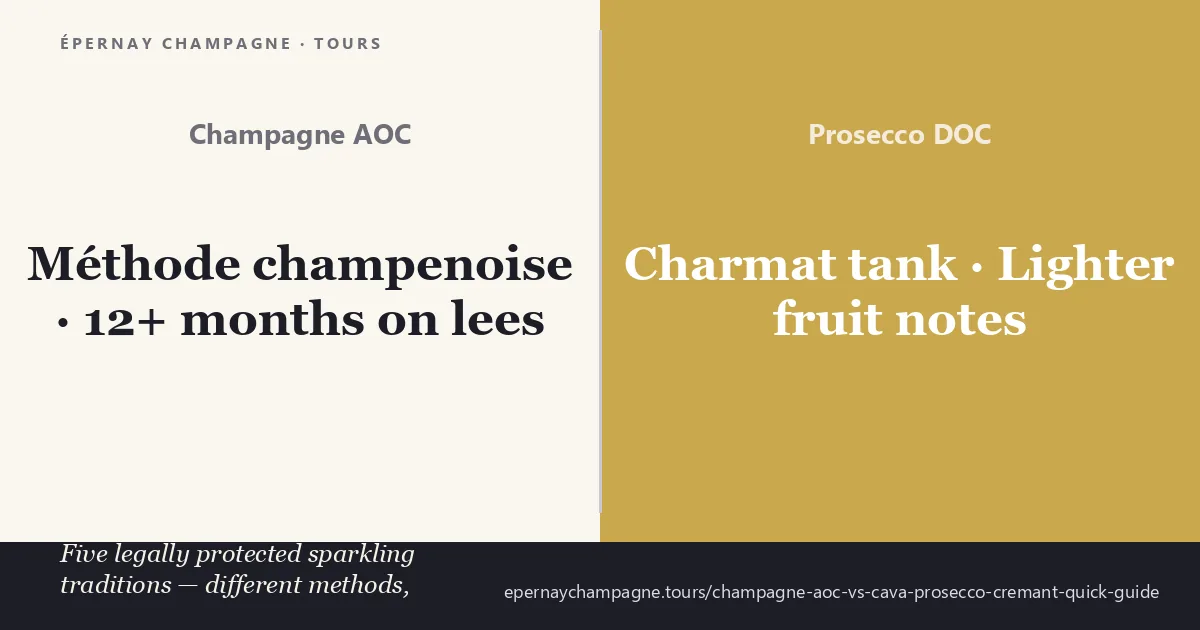
- Aging. Non-vintage Champagne must spend a minimum of 12 months on the lees, within a total minimum of 15 months from tirage (bottling) to release; vintage must spend at least 36 months on the lees
These rules are the reason Champagne tastes the way it does — and the reason the cellar tours show you the riddling racks, the pupitres, and the chalk crayères where the aging happens.
The méthode champenoise — what it is, what it isn’t
Méthode champenoise — also called méthode traditionnelle or “traditional method” outside Champagne — is the technique of producing sparkling wine through a second fermentation inside the finished bottle. Yeast and sugar are added to a still base wine, the bottle is sealed, and the second fermentation produces CO₂ that has nowhere to escape — so it dissolves into the wine as bubbles. The bottle then ages on its lees (the dead yeast cells), which add toast, brioche, and creamy texture over time. Riddling rotates the bottle to collect the lees in the neck; disgorging removes them; dosage tops the bottle up.
The term méthode champenoise is legally restricted to Champagne. Sparkling wines from elsewhere that use the identical technique must label it differently — “méthode traditionnelle,” “traditional method,” “metodo classico” (Italy), “método tradicional” (Spain), or “cap classique” (South Africa).
Cava — the Spanish traditional-method tradition
Cava is sparkling wine made in Spain using the traditional in-bottle method, principally from the Macabeo, Xarello, and Parellada grapes — the “trinity” of Catalan whites. Production is concentrated in the Penedès region of Catalonia, though the Cava DO designation allows production in several other Spanish regions.
The history matters: the first Spanish traditional-method sparkling wine was produced by Josep Raventós in 1872 in San Sadurní d’Anoia. The Cava DO regulatory body was formalised in 1972, exactly a century later. Modern Cava production includes Cava de Guarda (minimum 9 months on lees), Cava de Guarda Superior (minimum 18 months), and Cava de Paraje Calificado (the prestige tier, minimum 36 months — the same lees-aging requirement as vintage Champagne).
So when you compare a serious Cava de Paraje Calificado to a non-vintage Champagne, the technique is identical, the lees-aging is longer, and the difference is grape variety, climate, and terroir — not method. Cava is a legitimate tradition with its own legal protection, and the comparison should be read on those terms.
Prosecco — Glera, Charmat, and a different category
Prosecco is the most often-misunderstood comparison because its method is genuinely different. Prosecco is made principally from the Glera grape (formerly called the “Prosecco grape” — renamed in 2009 by EU Regulation 1166/2009 to protect “Prosecco” as a geographic indication tied to the production zone). The most common method is the Charmat-Martinotti tank method, where the second fermentation happens in large pressurised tanks rather than in individual bottles. This produces a lighter, fruitier sparkling style that emphasises primary fruit notes (apple, pear, white peach) rather than the toast and brioche that long lees-aging develops.
There are two main Prosecco protected designations: Prosecco DOC (the broader area covering Veneto and Friuli-Venezia Giulia) and Prosecco DOCG (the prestige hillsides of Conegliano Valdobbiadene, and the smaller Asolo DOCG). The DOCG areas are steeply terraced and produce structurally more complex Prosecco. A small minority of Prosecco DOCG producers use traditional in-bottle methods (Metodo Classico) or the col fondo “on the lees” style — but the vast majority of both DOC and DOCG remains tank-method.
Comparing Prosecco to Champagne is comparing two different categories of sparkling wine, not two grades of the same product. Prosecco is the right answer for an aperitif, for a fruit-forward sparkling, for value. Champagne is the right answer for toasted-bread complexity and long lees autolysis. Both are legitimate.
Crémant — the French traditional method outside Champagne
Crémant is sparkling wine made anywhere in France outside the Champagne AOC using the traditional in-bottle method. It is a separate appellation family — Crémant de Loire, Crémant d’Alsace, Crémant de Bourgogne, Crémant de Bordeaux, Crémant de Limoux, Crémant de Jura, Crémant de Savoie, Crémant de Die. Each Crémant AOC has its own grape rules, yield rules, and minimum lees-aging. Most require a minimum 9 months on lees (longer in some appellations).
Of the Crémants, Limoux is historically remarkable. Records at the Abbey of Saint-Hilaire near Limoux document Benedictine monks producing a naturally sparkling wine from around 1531 — over 130 years before Dom Pérignon arrived at the Hautvillers abbey in 1668. The Limoux story is genuinely older than the Champagne one; Dom Pérignon’s contribution was to refine the assemblage and the cellar discipline that made Champagne the most internationally recognisable version of the traditional method, not to invent sparkling wine.
Crémant is the most direct technique comparison to Champagne. Same method, often similar grapes (Crémant d’Alsace uses Pinot Noir and Pinot Blanc; Crémant de Bourgogne uses Chardonnay and Pinot Noir), different terroir, different price tier. A serious Crémant de Loire from a well-known producer is excellent wine.
Sussex sparkling — the youngest PDO in this conversation
The newest protected sparkling-wine designation in this family is English. Sussex sparkling wine received UK PDO (Protected Designation of Origin) status in 2022, making it the first wine-specific PDO in the UK. Rules require 100% Sussex-grown grapes, traditional in-bottle method, and similar varieties to Champagne (Chardonnay, Pinot Noir, Pinot Meunier). The chalk geology of the South Downs is geologically related to the chalk of the Champagne region — the same Cretaceous-era seabed surfaces in both places, separated by the English Channel.
Sussex sparkling is too young to have a settled style yet, but the best producers (Nyetimber, Ridgeview, Gusbourne in nearby Kent, Hattingley Valley in Hampshire) consistently win blind-tasting awards against Champagne. The serious comparison is straightforward: the same chalk geology, the same grapes, the same method, in a cooler climate that some critics argue is now closer to historical Champagne than modern Champagne is.
Side-by-side summary
| Wine | Region | Principal grapes | Method | Legal protection | Typical age on lees |
|---|---|---|---|---|---|
| Champagne | Champagne, France | Chardonnay, Pinot Noir, Pinot Meunier | Méthode champenoise (in-bottle) | AOC 1936 (delimitation 1927) | NV ≥12 months; Vintage ≥36 months |
| Cava | Penedès + others, Spain | Macabeo, Xarello, Parellada | Traditional in-bottle method | DO 1972 (Raventós produced first in 1872) | Guarda ≥9 months; Paraje Calificado ≥36 |
| Prosecco | Veneto + Friuli, Italy | Glera | Charmat-Martinotti tank method | DOC + DOCG (Glera renamed 2009 EU Reg 1166/2009) | Tank; short |
| Crémant (various) | French AOCs outside Champagne | Varies by appellation | Traditional in-bottle method | Multiple AOCs | Usually ≥9 months |
| Sussex sparkling | South Downs, England | Chardonnay, Pinot Noir, Pinot Meunier | Traditional in-bottle method | UK PDO 2022 | Varies; many follow Champagne aging norms |
Why this matters when you visit Champagne
When you tour a Champagne cellar, the things being shown to you — the riddling racks, the chalk crayères, the pupitres, the marks on the bottles — are not unique to Champagne as a technique. They are unique to Champagne as a place. The grape rules, the legal delimitation, the méthode champenoise label, the long lees-aging culture, and the role of the CIVC in setting yields and protecting the appellation are what make Champagne specifically Champagne. The sparkling wines elsewhere are legitimate cousins with their own protected status.
The yield rule is not abstract. In 2024, mildew, spring frost, and hail cut the Champagne harvest by roughly 46% versus the record 2023 crop, and the CIVC set the commercial appellation yield at 10,000 kg/ha. For 2025 — described by several Maison cellar-masters as one of the strongest vintages in three decades despite an unusually early-August picking start — the CIVC capped the marketable yield at 9,000 kg/ha (the lowest cap of the modern era apart from 2020), against an agronomic yield estimated near 11,000 kg/ha. Those numbers are the AOC machine working: protecting both the appellation and the long-term price floor that funds the cellar tour you are about to take.
This framing matters for two reasons. First, it makes the cellar tour more interesting — you understand what the law actually protects, and what the wine actually is. Second, it lets you taste comparatively without being snobbish. A good sommelier will pour you a Champagne and a Cava de Paraje Calificado side by side and explain what the long lees-aging and the chalk terroir contribute. That comparison is the whole point of a lunch-pairing class.
For a deeper walk through Champagne house styles, see our grandes marques decision guide. For practical etiquette before you visit, see our Champagne cellar tasting etiquette guide.
Ready to Book?
The clearest way to actually taste the difference is a structured class with a working vigneron. Our Champagne lunch-pairing class is a 3-hour seated masterclass at $111 (399 verified reviews at 4.91/5) — three Champagnes, traditional lunch, the AOC story explained by someone who lives inside it.
Taste It With Context — Lunch-Pairing Class
A 3-hour seated masterclass at a Champagne vigneron — three Champagnes, lunch, the AOC story explained by someone who lives it. The highest-value format on our site at $111, with 399 verified reviews at 4.91★.
See the Lunch-Pairing Class