Champagne Cellar Tasting Etiquette & Dress Code
What to wear, how to taste, what to do (and not do) at a Champagne Maison cellar visit — practical first-timer guide. Chalk floors, 10-12°C, formal lunch.
A first Champagne cellar visit is intimidating for one simple reason: nobody tells you what to expect. The cellars are colder than you think, the tasting protocol is more structured than at a typical winery, and the right outfit is genuinely useful — not because Champagne is snobbish, but because the chalk floors are uneven, the cellars are 10–12 °C year-round, and you will likely transition straight into a seated lunch. This guide covers what to wear, what to bring, how to taste, and what to do (and not do) so the visit feels relaxed instead of awkward. If you want a low-pressure practice run, our lunch-pairing class is the gentlest entry point — a 3-hour seated masterclass with a working vigneron.
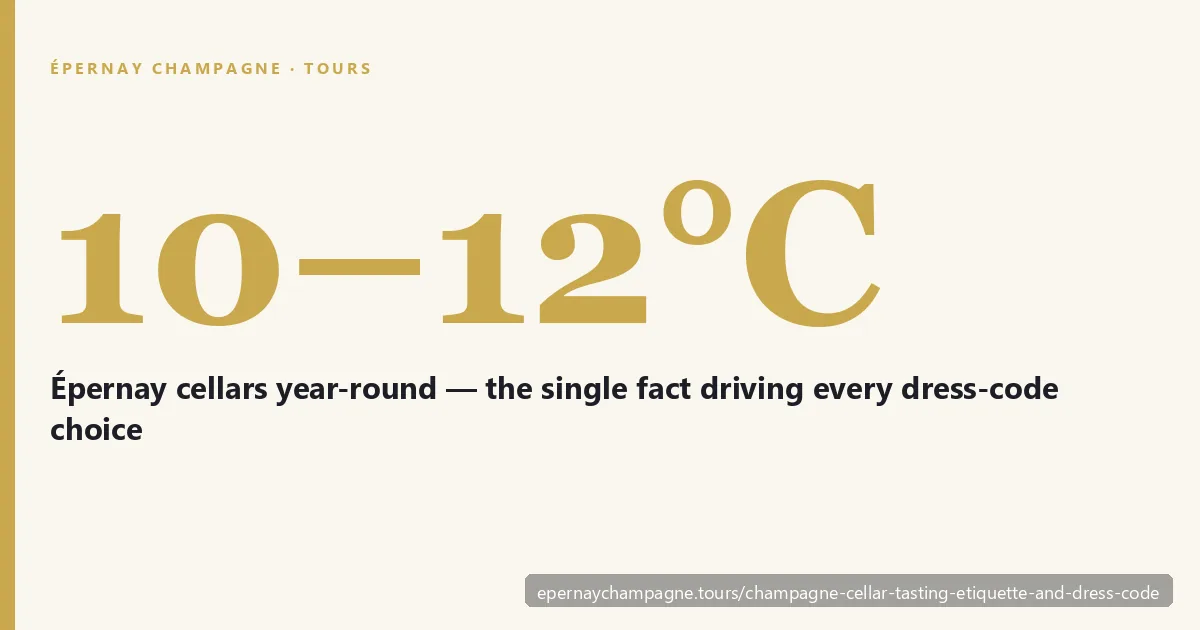
The single most important fact: the cellars are cold
Champagne cellars (the chalk crayères under Épernay and Reims) maintain a constant 10–12 °C year-round. This is the same in July as in November — the chalk regulates temperature naturally, and air-conditioning is not used. Cellar walks typically last 45–90 minutes. If you arrive in a summer dress and sandals, you will be uncomfortable within ten minutes.
What to wear:
- A layer you can put on at the cellar entrance — a light fleece, a cardigan, a tailored jacket. Maisons can lend a cloak on request, but the request needs to be made at reception, not mid-tour.
- Closed-toe walking shoes. Chalk floors are uneven, sometimes damp, occasionally slippery. Heels are not workable. Light hiking shoes, leather flats, or oxfords all work.
- Layered tops. You will descend into 10–12 °C, return to a tasting salon at around 18–20 °C, and (on most tour packages) move straight into a seated lunch in a room kept comfortable. Layers give you adjustment room without needing to manage a heavy coat.
- Trousers or longer skirts over short skirts or shorts — the cellar walk is long enough that bare legs in 10 °C become genuinely cold.
What you do not need to wear:
- Champagne cellar tours do not have a formal dress code. Smart-casual is the norm at all five grandes Maisons covered on this site. A tie, a cocktail dress, or a suit are not required — they are also not out of place.
- Hats and sunglasses come off in the cellar; leave them at the cloakroom or in your bag.
- Heavy perfume or cologne interferes with the tasting — the cellar-master may politely note it. A light scent is fine; a heavy fragrance is genuinely disruptive in a small tasting salon.
What to bring
A short list:
- Photo ID. French AOC tasting law requires legal age 18; some Maisons spot-check ID at the tasting salon for younger-looking guests. Bring a passport or driving licence.
- Cash or card for the boutique. Most Maisons run a boutique attached to the tasting salon. If you plan to buy bottles (especially Vintage or limited cuvées), bring a method of payment. Customs declarations apply to bottles taken outside the EU — keep the receipt.
- A water bottle between visits if you are doing a multi-stop day. Tasting saliva builds up; rehydration matters.
- A small notebook if you take tasting notes. Many Maisons hand out a tasting card, but a personal book is welcome.
- Comfortable layers in a small bag for the temperature transitions.
How a typical cellar visit unfolds
| Stage | Duration | What happens |
|---|---|---|
| Welcome at reception | 5 min | Check-in, group assembly, brief overview |
| Facade and exterior context | 5–10 min | History of the Maison, location, family background |
| Descent into the crayères | 45–60 min | Underground walk through the cellars, riddling-rack hall, vintage galleries; guide narrates production process |
| Tasting in the salon | 30–45 min | 2–3 cuvées poured by the cellar-master or a senior server; guided tasting notes |
| Boutique time | 10–20 min | Optional purchase, last questions |
Total: typically 90–120 minutes for a standalone Maison cellar tour. Booked day tours bundle 2–3 of these stages in a single day, plus lunch.
Tasting protocol — what to actually do
The basic Champagne tasting sequence:
- Look. Hold the glass against a white surface — the menu card works. Note the colour (pale straw → deep gold → pink), the brilliance, and the bead (the bubbles). Smaller, persistent bubbles in a steady vertical column suggest longer lees-aging.
- Smell. Aerate by gently swirling (a flute makes this hard, which is why serious tastings use tulip glasses). First nose: fresh fruit, citrus, white-flesh fruit. Second nose: deeper notes — brioche, almond, butter, sometimes nougat or honey on aged cuvées.
- Taste. Hold a small sip in the mouth, draw a little air across the wine (“aspirate”), and note three things: the attack (first impression), the mid-palate (texture, weight), and the finish (length, dryness). Champagne should have a clean dry finish even on the sweeter dosages.
- Discuss, do not ask “is it good?” Ask the cellar-master what the assemblage is, how many years on lees, what the dosage level is (Brut, Extra Brut, Brut Nature, Demi-Sec). These are the right questions.
If you do not finish a glass, that is normal — the cellar-master will offer a spittoon or a discard bucket. Spitting is professional, not rude. Driving back to Paris after multiple tastings without spitting is a meaningful legal risk in France (and a quiet way to feel awful for the second half of the day).
What not to do
A short list of mistakes that mark a first-timer:
- Do not request specific vintages on the spot. Cellar tours offer the cuvées the Maison has chosen for the public visit. If you want a particular vintage, that is a separate booking (often a paid upgrade).
- Do not photograph the riddling-rack area aggressively. Some Maisons restrict photography in production areas for trade-secret reasons. The guide will tell you where photos are welcome. Quick personal photos in approved areas are fine; flash photography is generally not.
- Do not over-tip. Tipping in France is not the US norm; the booked tour fee or Maison entry fee covers the cellar-master’s service. A small thank-you tip of €5–10 for an exceptional guide is appreciated but not expected. For a private chauffeur tour, a 10% tip at the end of the day is reasonable.
- Do not arrive late. Cellar visits are time-blocked; latecomers may be turned away or merged into a later tour. Arrive 10 minutes early, especially in shoulder season when the lobby fills.
- Do not bring children to a tasting flight. Children 6+ can join the cellar walk at most Maisons (no tasting); some Maisons require minimum age 12 for the cellar visit because the descent is long and the floors are uneven. Under 18 cannot taste — this is French AOC law, not Maison preference.
The lunch — formality calibration
Most booked Champagne day tours include lunch at either a grande Maison restaurant, a vigneron farmhouse, or a regional restaurant in Épernay or Reims. The formality varies sharply:
- Vigneron farmhouse lunch: smart-casual, the family sits with you, the wine is from the producer’s own bottling, the food is regional (saucisson, terrines, chaource cheese, tarte aux mirabelles). Relaxed and warm. The format the most-booked Paris-to-Épernay day trip uses.
- Grande Maison restaurant lunch (Le Royal Champagne, L’Assiette Champenoise, Les Crayères): smart, often Michelin-starred, longer pace, expect 2.5–3 hours seated. Jacket recommended for men, smart equivalent for women.
- Tasting class with lunch (the format used by our lunch-pairing tour): seated at a working vigneron’s tasting room, lunch on regional charcuterie and cheese, paired with three Champagnes — the gentlest format and the highest-rated by reviewers (4.91/5 across 399 verified bookings).
A short pre-visit checklist
Run through this the night before:
- Photo ID packed
- Closed-toe walking shoes (not sandals or heels)
- A layer (fleece, cardigan, light jacket) for the cellar
- Booking confirmation on phone, printed if backup useful
- Cash and card for boutique
- Light breakfast — heavy meals dull tasting; coffee is fine
- Skip strong cologne or perfume
- Allow 90–120 minutes per Maison visit plus transit
- If self-driving: arrange a designated non-tasting driver, or budget for a chauffeur
For the wider context of what you are actually tasting, see our Champagne AOC vs Cava, Prosecco, Crémant guide. For a structured walkthrough of the Moët flagship visit specifically, see Moët & Chandon Épernay cellar tour: what to expect.
Ready to Book?
The most reviewer-friendly first Champagne tasting is the lunch-pairing class — a 3-hour seated masterclass with a working vigneron, three Champagnes, traditional lunch, and the AOC story explained without snobbery. From $111, 399 verified reviews at 4.91/5.
Practice With a Pro — Lunch-Pairing Class
The fastest way to feel confident at a Champagne tasting is to take a structured class first. 3 hours, three Champagnes, traditional lunch, a working vigneron walking you through the tasting protocol — $111, 399 verified reviews.
See the Lunch-Pairing Class